
What a Client-Ready Content Brief Needs
Create a client-ready content brief that sets the audience, angle, evidence, boundaries, and review decision before drafting begins.
 Joe HandayaChief Product Officer
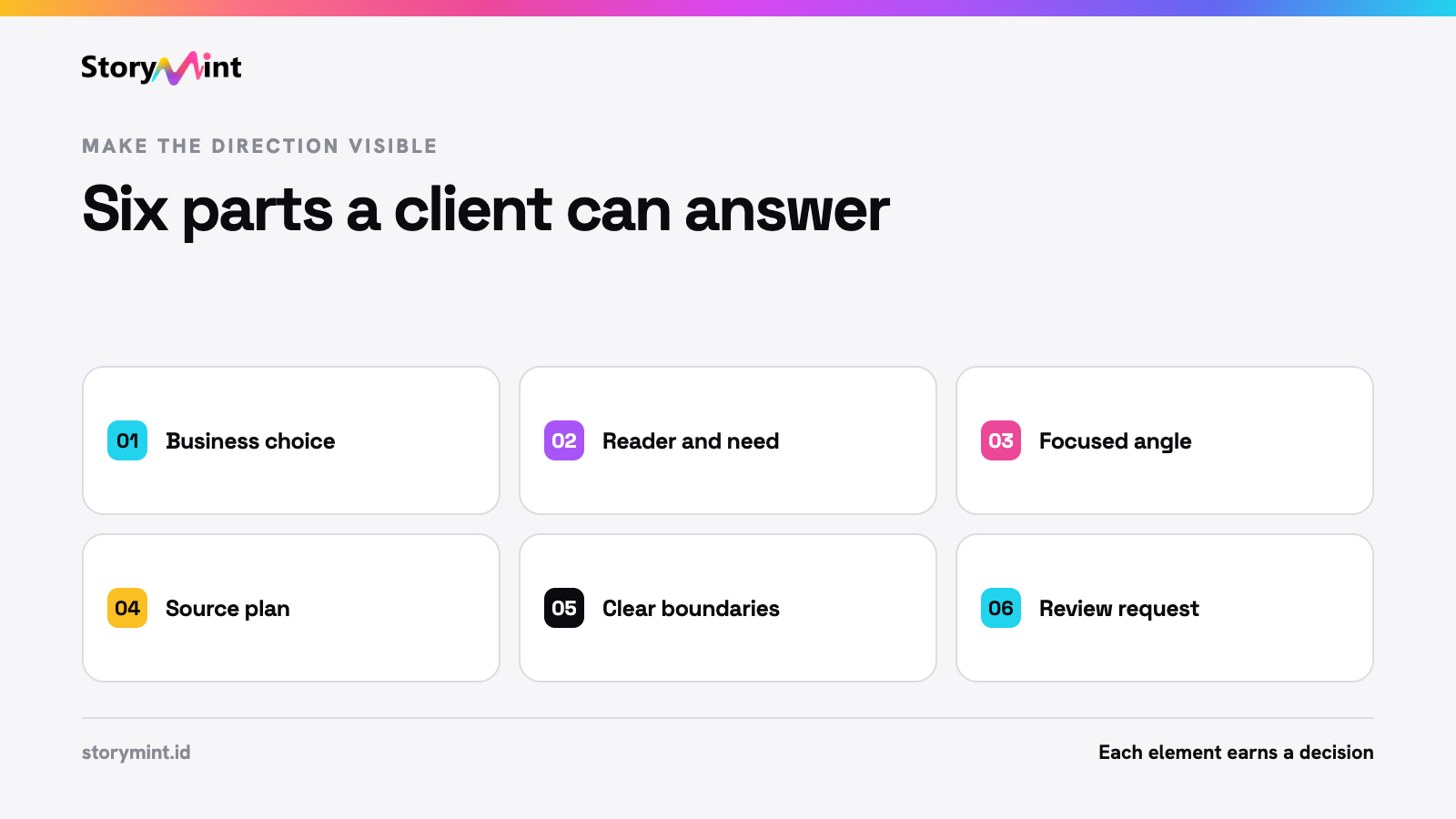
A content brief should give your client a decision to make before anyone starts a draft. That is different from handing a writer a list of keywords, a loose topic, and a deadline. A useful brief explains why this piece belongs in the plan, who it must help, what it can credibly say, and where its scope stops.
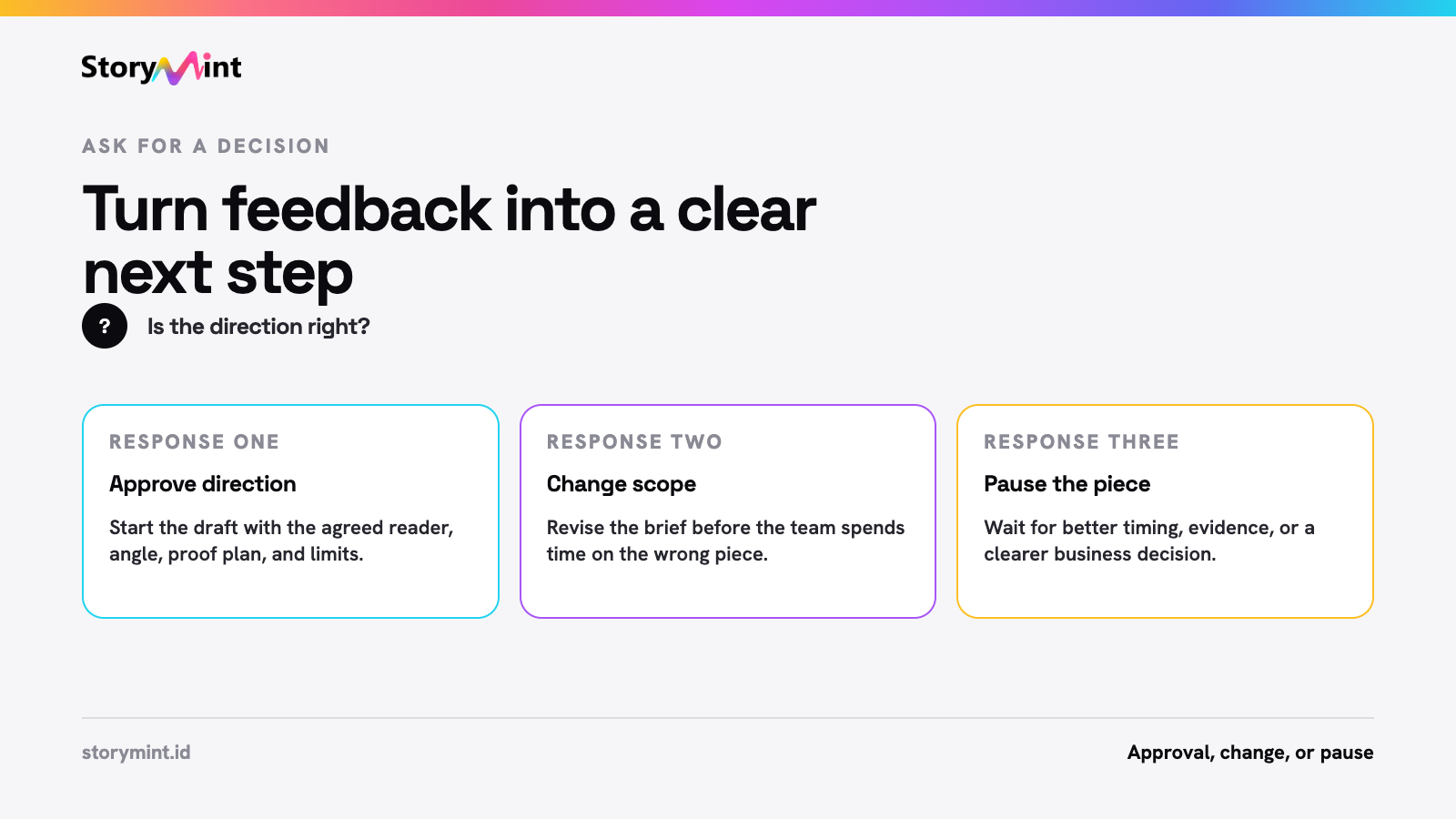
For an agency, that clarity matters because production is not the only cost of an unclear request. A vague approval can send the team into a cycle of changed angles, new source requirements, and feedback that arrives after the central decision should have been settled. A client-ready content brief gives the client a smaller, more useful choice: approve the direction, change it, or pause it before the work becomes expensive to reshape.
Approve the decision before the draft
Treat the brief as a decision document first and a writer hand-off second. The client does not need every sentence in advance. They do need to know the business choice behind the piece and the audience problem it is meant to answer.
That changes the review from "Do you like this topic?" to "Is this the right content decision for the audience and goal we agreed?" It also gives you a record of what was approved when later feedback shifts. A strong brief makes disagreement visible early, while there is still room to change course without rewriting a finished article.
Start with the business choice
Open with one plain sentence that states why this content deserves a place in the plan. It might support a product launch, answer a recurring buyer question, help an existing audience understand a change, or give a sales team a useful explanation to share. Do not settle for a broad aim such as "build awareness" unless the client can explain what that means for this piece.
Then name the decision the content is designed to support. For example, a client may ask for an article about AI search. The brief could narrow that into a decision: help content leaders decide which parts of their public information should be clearer when answer engines describe the brand. The article is no longer about a large subject. It has a job that a reader can recognise.
If the opportunity came from a known gap, link it back to the finding rather than treating the idea as a hunch. StoryMint's guide to content gap analysis can help your team identify a missing opportunity before you ask a client to approve the response.
See the decision in action
Here is what that looks like in a real campaign rather than in theory. On 24 August 2026, a StoryMint Query Fan-Out analysis started with this question: “How can an agency get a client to approve a content brief before drafting starts?” It expanded the question into 15 sub-queries. Seven had no matching page in the campaign inventory: client approval, comprehensive brief elements, objectives and KPIs, strategic justification, content pillars, calls to action, and brief presentation.
That result is not proof of search demand or a guarantee that the article will perform. It is a useful decision record. The brief can now say that the proposed piece owns the client-approval question and the elements of a comprehensive brief, while deliberately leaving format, SEO, distribution, and collaboration-tool questions to pages that already cover them. The client is approving a specific response to a documented gap, not a broad idea about “content briefs.”
Give the reader a real job
"Content leaders" or "small businesses" are audience labels, not reader needs. Add the situation that makes someone read now and the action they should be able to take afterwards. A content leader who needs to decide what to improve before the next planning cycle has a clearer job than a general audience interested in AI search.
This is where an audience-first brief earns its place. Google asks creators to consider whether content serves an existing or intended audience, helps readers achieve their goal, and adds value beyond what is already available. Read that people-first content guidance as a test of usefulness, not as a promise about search performance.
You can also connect the proposal to the audience work already happening elsewhere. StoryMint's article on audience needs is a useful reminder that a change in distribution does not remove the need to understand the people you are trying to help.
Make the angle earn its place
The angle is the specific promise of the article. It tells the client what the reader will get that a familiar summary would not give them. A broad request such as "write about AI search" can become a focused article about reviewing public information before a content update. The point is not to make the title more clever. It is to decide what the article will explain, for whom, and why that explanation is worth making now.
Write the angle in one sentence, then add the expected takeaways. Keep those takeaways concrete. In the AI-search illustration, a reader might leave with a way to list the public facts that answer engines may repeat, identify gaps that need evidence, and decide which page needs a clearer explanation. Do not add claims about visibility, rankings, or results unless the brief contains evidence you can check.
Show the proof behind the plan
Before a client approves the idea, show what will keep the article grounded. List the primary sources, product documentation, approved brand material, or examples you expect to use. Name what each source can support. If a claim has no source, it does not belong in the brief as a promised point.
This proof plan is particularly useful when a proposed article touches a product or a changing platform. It separates what the team knows from what still needs verification. It also gives the client a chance to add a source, correct a product fact, or remove a claim that would create risk.
For work that uses StoryMint, keep the product detail proportionate. Its Content Writer workflow moves from source to brief to draft, with a title, persona, and channel as the core brief details. That is a practical hand-off, not a substitute for the human decision about the audience, angle, evidence, and limits.
State the boundaries in writing
Boundaries stop a brief from becoming a blank cheque for extra topics. Say what the article will not cover, which claims it will not make, and where a related subject belongs instead. This is not defensive writing. It gives the client a clear way to judge the shape of the work.
In the AI-search illustration, the boundaries might exclude unverified performance claims, product comparisons without source material, and a broad prediction about how every answer engine will behave. The article can still be useful because it answers one defined reader need with material the team can support.
Write down any language, compliance, product, or brand limits at this stage too. StoryMint's Brand Voice documentation describes a profile that brings together style, tone, do and do not rules, and vocabulary guidance from sample content that represents the brand. Those rules help the agency and client assess whether the intended angle will sound like the brand before a draft introduces avoidable debate.
Ask for the right response
End the brief with the exact approval you need. A client does not have to approve every future sentence. Ask them to confirm the business choice, intended reader, proposed angle, proof plan, and boundaries. Make room for a third answer as well: pause the piece because the timing or evidence is not right.
Keep the review request short enough to answer in one meeting or one written reply. If the response changes the reader or the angle, revise the brief before production. If it changes only a minor example, record that decision and continue. This keeps the client involved at the point where their judgment has the most value.
Carry the approved brief forward
Once the direction is settled, the brief should travel with the work rather than disappear into an email thread. StoryMint's Content Calendar lets your team plan and schedule a piece, then view the pipeline by status, type, and source. A writing workflow can carry the agreed brief into the next draft. The client should still see the judgment behind the content, not only the finished prose.
When your client can approve the decision in front of them, move the direction into StoryMint Content Writer to shape the long-form brief before generating and refining a draft. Review the direction first, then write the piece.


